

“If it ain’t broke, don’t fix it.”
I heard this saying a lot growing up, and for many years I’ve agreed wholeheartedly with it. After all, if something is already doing what it’s supposed to do, why should I spend any more time and effort on it?
But now that I’m older, I’ve started to realize just how flawed that way of thinking can become if I let it.
Just because something is working, it doesn’t necessarily mean that it’s working well.
If you’re using Linktree to share links to your stuff, I want to show you a better way to do it. It’s so simple, I can’t believe I never thought of this before.
Starting My Website Journey
I’ve had a website for a few years now where I post articles, share book news, and provide free resources to readers and writers. Every week I get an email with a report that tells me how many people have visited my site. When I first started posting articles to my website, I only got around 100 website visits a week—which made complete sense to me since it had only been a few weeks. I was sure that over time, as I continued to post articles and grow my mailing list, I would definitely get more web traffic to my site.
I started using a website called Linktree for Instagram and all my other social media platforms. I’m sure you’ve seen it before. Since Instagram used to only allow you to have one link in your profile, Linktree created a simple page that you could send people to where they could find the links to all of your stuff.
Even though you can now include multiple links in your Instagram profile, you still don’t want to overwhelm someone with too much stuff there.
As an example,here’s what The Company’s Linktree looks like:

Linktree made it possible for me to share links to my website, mailing list, books, and other important information. All people had to do was click on the one link, and suddenly they had access to whatever content I wanted to promote.
It was simple and it worked. But it didn’t work well enough…
No Growth
Back in November of 2024, I noticed that my website visitor count was stagnant. I’d get a ton of bot traffic, but barely any human visitors.
Now and then I’d reach around 1,000 visitors a week, but other times I’d barely break the 300 mark.
If I was doing everything right—being fairly consistent with my content, sending out newsletters, and posting links to my articles on social media—why wasn’t I seeing major improvements from when I first started a few years ago? Obviously, I had made some progress, so my methods weren’t completely broken, but since my goal has always been to keep growing, something needed to change.
Suddenly I realized: it was cool that Linktree allowed me to share lots of links in one place, but why couldn’t I do the same thing on my own website instead?
A New Theory
I heard another writer mention that she had a “directory” page on her website, and I thought, “Why couldn’t I create my own Linktree?”
It makes a lot more sense to drive web traffic straight to my website instead of to a third-party site. I was a little nervous about making the switch since I knew it would take some time and experimentation to figure out how to create the page’s layout, and part of me was afraid that I’d mess something up, but I really wanted to find a way to improve my numbers. And while websites like Linktree have been helpful to me in the past, you have to pay for a lot of their really good features.
Having the links on my own website means that I’ll always have complete creative control over how my page will look and operate.
Putting It Into Practice
So, I set up my own link page. Now when someone finds my profile on social media, I send them to a page on my own website with direct links to my books, free resources, social media platforms, and articles. Putting it on my own website allowed me to make it look a lot cooler and easier to use for my visitors. Plus, I was directly capturing all of the traffic!
Here’s what my new “link tree” looks like on my own site:
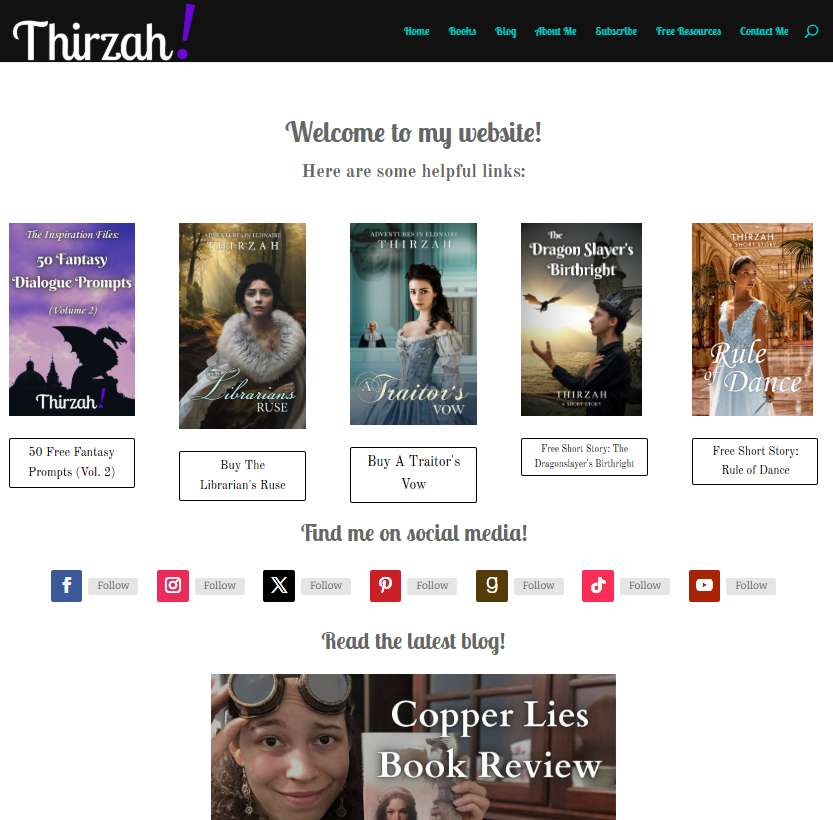
(This is the desktop version, but it also automatically scales for phone users!)
Of course what really matters is the results. When my next report came in I was shocked to find that I had gone from 529 website visitors, to 2,194.
At first I thought it was just a coincidence, but the next week the report came in with 2,658 website visitors, and the week after that it was 2,613. In fact, ever since I stopped using a third-party website my weekly website visitors haven’t dropped below the 2,000 mark.
I’ve also found that the amount of bot traffic has decreased as well. I used to get thousands of bots visiting my website, and I’d also have to deal with a bunch of spam comments. Now, the only comments I receive on my articles are from real people who have actually read my articles.
How to Make Your Own Directory Page
If you’re ready to abandon Linktree and make your own directory page, it’s so easy!
1. Create a new page
At The Company, we always point people towards WordPress to build your website. If you’re using WordPress, simply create a new page. Make the title of the page something simple like “Information” or “Directory.” Whatever you put as the title will also become the URL and you want it to be easy to share. For instance, yoursite.com/information or yoursite.com/directory.
(For advanced users, you can also manually change this by setting the “Slug” in the “Quick Edit” menu.)
2. Place your links on the page
You can make the page as fancy as you want, but simple is usually best. Remember that Linktree was just a list of links, so don’t go overboard.
For mine, I included my book covers, but if you don’t have stuff like that yet, don’t worry about it. It can be as simple as a list of text links!
In my example, I’m using a theme called “Divi” that allows me to have a lot of control over the design. If yours is simpler than this, that’s OK! It will still do its job.
3. Things to include on your directory page
Keep your directory page simple. You don’t want to overwhelm your visitor with options. You’re just trying to get them to the most important things you’ve recently been promoting.
Whenever you add something new, make sure that you’re removing old links from the list. Even if the “old” thing is still something you want to promote, if you’re not actively talking about it on social media or in your newsletter, drop it for now. You can always add it again later!
It’s also a great idea to include things like:
- Links to your social media accounts
- Your most recent blog posts
- A signup form for your newsletter
Think of your directory page like a “Quick Start Guide.” You have a new fan! What are the most important things you want to connect them to?
Worth The Risk
All in all, I’d say that my little experiment turned out to be a big success.
But what if I had decided not to take that risk?
I could have decided to just be satisfied with the numbers that I had, and ignore the fact that I wasn’t seeing any growth despite all the time and effort I’ve put into building my website and writing articles over the past few years.
Since trying this experiment, I’ve realized that the “If it ain’t broke, don’t fix it” mentality doesn’t work if you actually want to see growth and improvement in your business, relationships, or any other aspect of your life.
I don’t want to get sucked into the trap of mediocracy just because I don’t feel like putting in the work, or because I’m too afraid of the risks that come with trying something new.
Living A Life of Improvement
“Good enough” isn’t always good enough. So perhaps instead of saying “If it ain’t broke, don’t fix it” we should be saying, “If it ain’t broke, ask yourself if you can improve it.”
And if the answer is yes, don’t be afraid to take that risk. You may be pleasantly surprised by the results.

Thirzah is a graduate of The Company’s apprenticeship program and the author of the Adventures in Eldnaire series. She currently lives in Maryland.
Connect with Thirzah on her website at ThirzahWrites.com, and find links to her most important stuff on her directory page here: thirzahwrites.com/information/
Never miss another tip! Stay in the loop with The Company by subscribing to our free newsletter. Use the form below, and we’ll also send you The Three Publishing Paths, an invaluable publishing guide:

This is such a good idea, Thirzah!
Thanks, Melissa! I hope it will help other people as much as it’s helped me. 😊
Oo, I love this idea! I’ve been trying to grow my website traffic recently and feeling stuck so I’m definitely going to implement this onto my site.
Thank you, Thirzah!!
You’re so welcome, Bella! Let me know if it helps you grow!
Wow! I’m trying this ASAP. Thanks, Thirzah!
Great idea! The link tree I use is so cluttered and not pretty! Yours is so appealing. Trying this soon!